
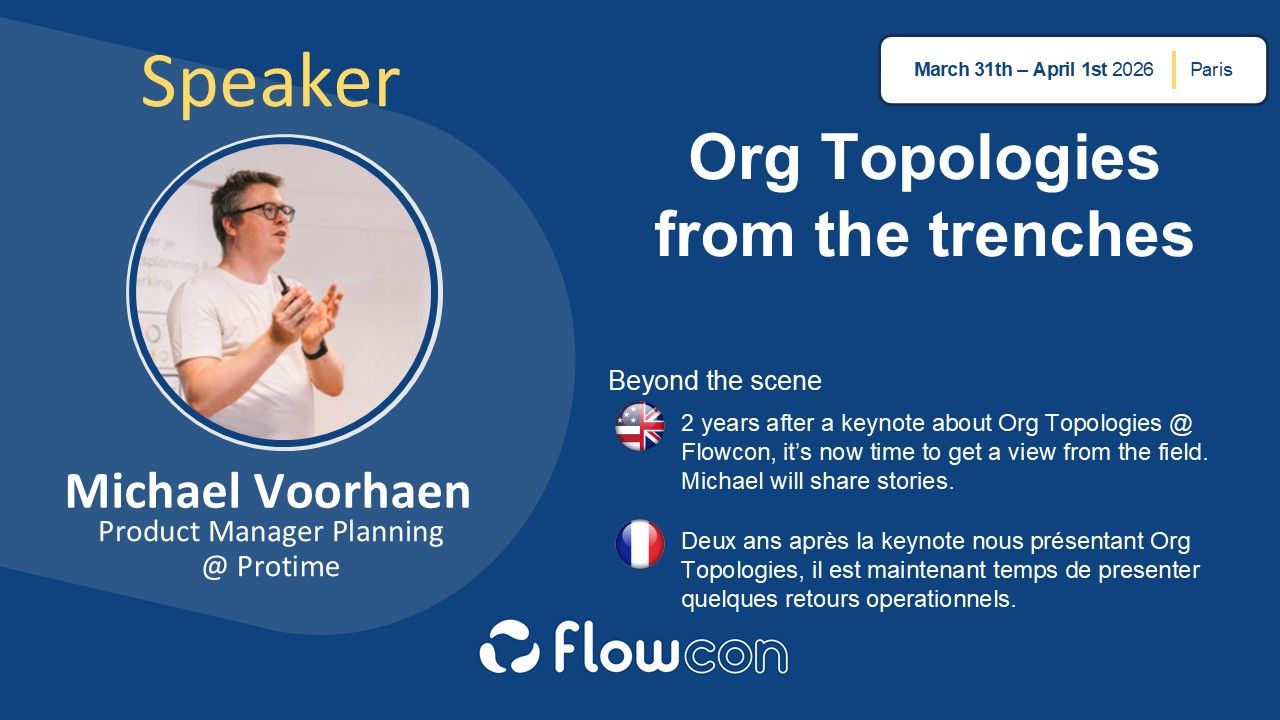
Flowcon 2026: Org Topologies from the trenches
A deeper follow-up to my LeSS talk, with the added complexity of a second product
If you’ve ever felt that delivery problems were really org design problems in disguise, this talk will probably feel familiar.
If you’ve seen my LeSS Meetup NYC talk, this Flowcon session builds on that same story.
It’s also a follow-up to Alexey Krivitsky & Roland Flemm’s FlowCon keynote, The value of Org Topologies in the era of DIY-frameworks.
I cover the same foundation as in the LeSS talk: how Strobbo went from fast startup execution, into a scaling slowdown, and then gradually worked its way back toward business agility. But here I make the Org Topologies part more concrete and show how you can use it to drive a change like this, not just to describe it afterwards.
And unlike the previous talk, I add the additional complexity of a second product. I also bring in the moment where Strobbo’s planning engine became part of myProtime Planning, and how that pushed us to rethink the setup: new team boundaries, shared events, product-specific refinements, and new ways for both products to learn and move together.
Inside the deck, I walk through:
- how we put everything on the map, how MADE can help you improve it, and what moves we made on the map later
- the elevating katas that helped us move toward a more adaptive topology working on outcomes
- how outcome-focused roadmaps, bets, and shared planning routines changed the conversation
- how the picture changed later when myProtime Planning entered the story and both products shared underlying components
- why PMs and POs should care about org design instead of treating it as someone else’s problem
I also close with the experiments we’re running now: smaller teams, faster shaping, and more deliberate choices about what we actually want to optimize for. AI is part of that story too, but as one of the means to that end rather than the end itself.
If you’d like to go through the full deck, you can download the slides here.