
LeSS Conference 2025
Insights and Reflections from Amsterdam
The 2025 Global LeSS Conference Amsterdam was really worth it. Meeting up with old friends, sharing experiences, inspiring presentations, and with the open space I had so much trouble choosing what to attend.
I’ve tried to capture some of my notes here. Contact me if you’re interested in discussing something in more detail.
- Day 1 - Keynote by Alistair Cockburn: It’s still about the People even with AI
- Day 1 - Roland and Ralph’s Talk: Doing a LeSS Flip in two months (A TURBO LeSS Adoption At Greenflux)
- Day 1 - My Talk: The Strobbo Experiment: Elevating Katas on the Road to Business Agility
- Day 2 - Keynote by Bas Vodde: The Product Backlog
- Day 2 - Keynote by Maarten Dalmijn: Escaping the Kraken
- Day 2 - Tom Jans’ Talk: Strongly Committed Teams — A Theory from Philosophy Applied to My Latest LeSS Flip
- Day 1 & 2 - Open Space Sessions
- Day 1 & 2 - Open Space — Talking to Leadership and Management about LeSS
- Day 2 - Open Space — Strategic AI vs Naive AI
- 📚 Books Referenced at the LeSS Conference 2025
Day 1 - Keynote by Alistair Cockburn: It’s still about the People even with AI
Speaker: Alistair Cockburn
I’m not going to unpack everything that was in Alistair’s presentation, but some small things that stuck with me:
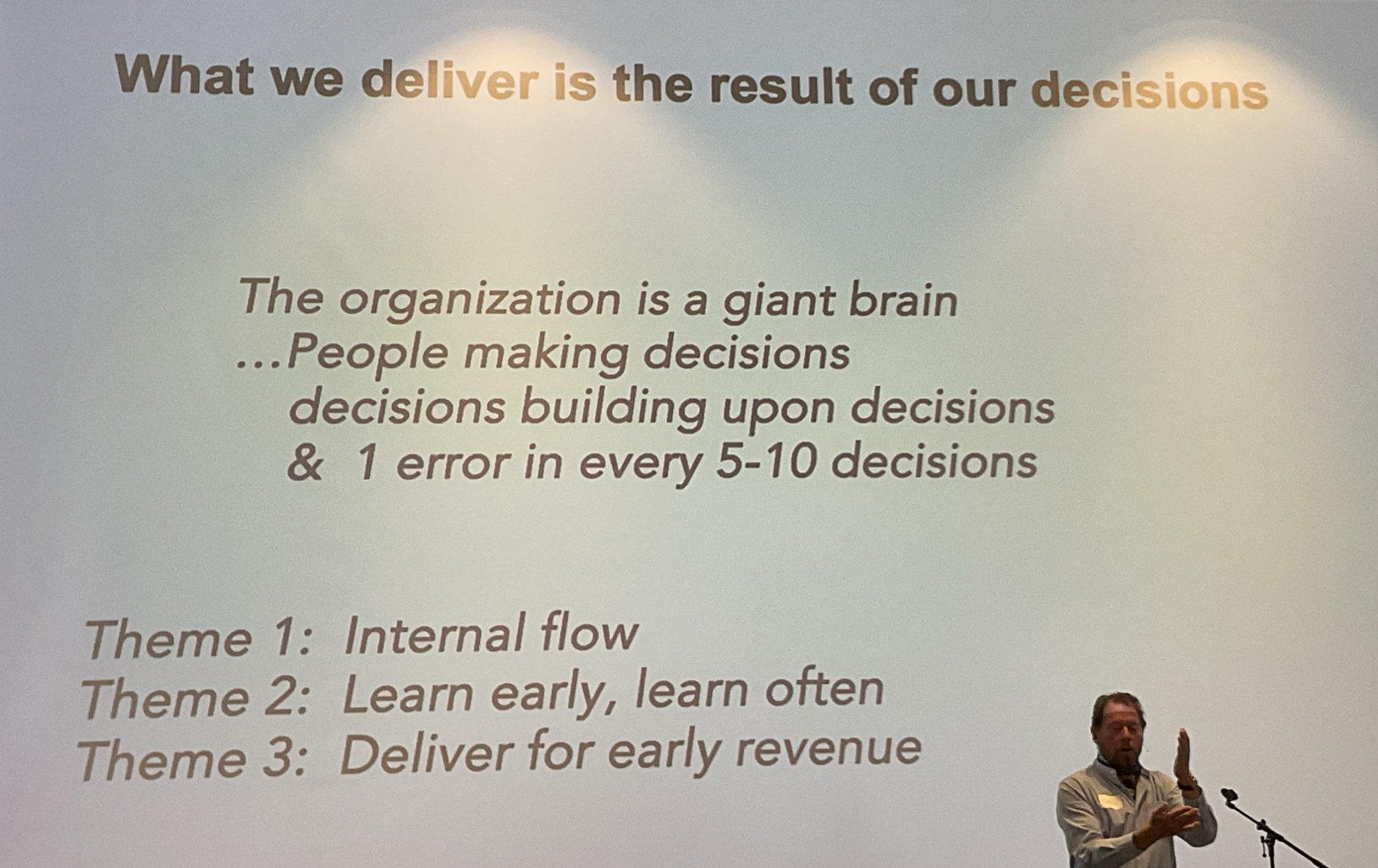
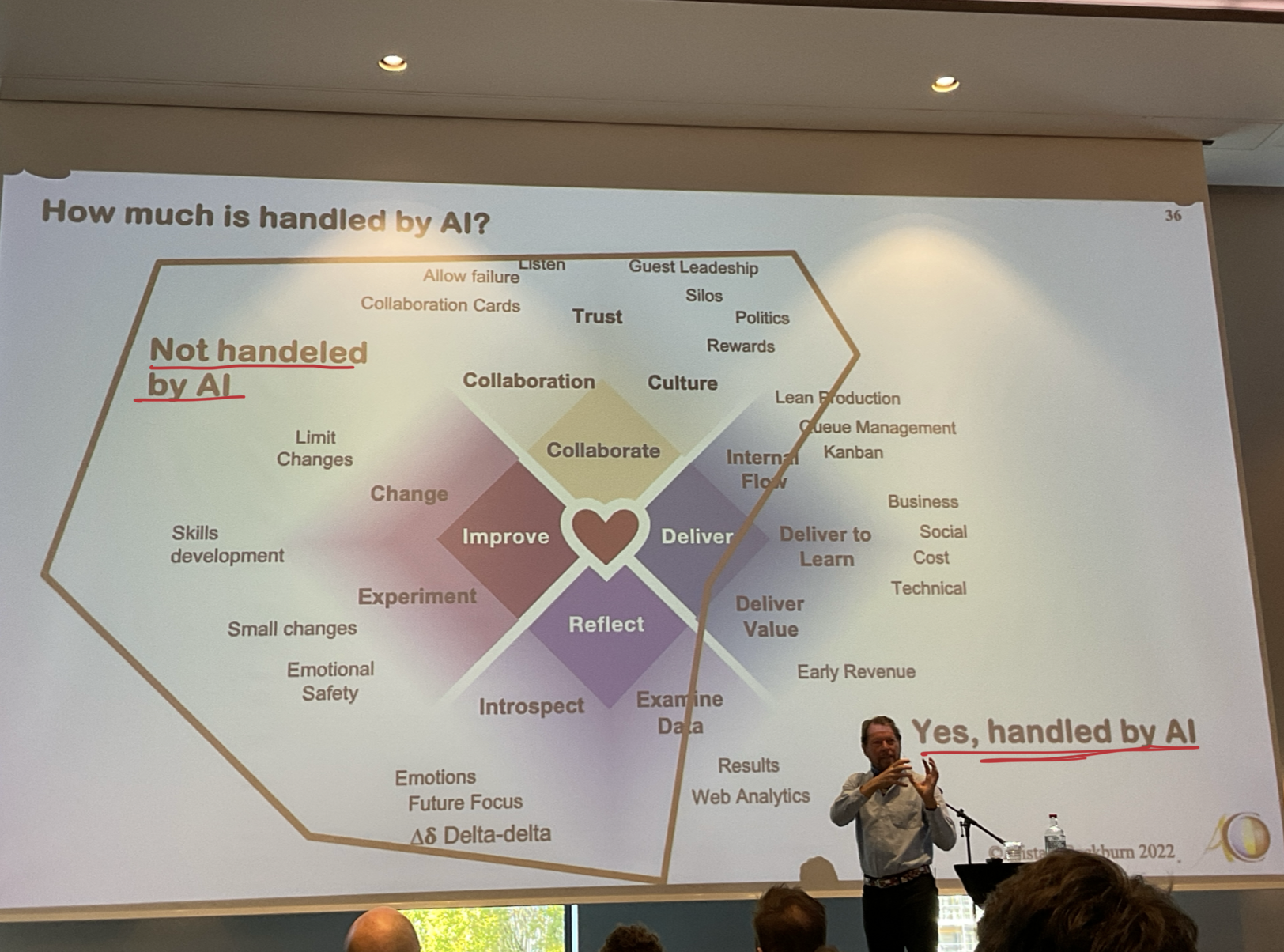
Organizations are complex systems and I liked his analogy with a giant brain. Everyone is continuously making decisions and those build on top of each other. And we need to understand that errors will occur — in his talk he mentions 1 error in every 5 to 10 decisions. We need to learn to design our organizations in such a way that errors don’t stack, but that we can learn early from them. When you think about this, it’s a call for simpler organizations — just adding quality gates here and there doesn’t solve anything as mistakes will be made there too.
And then of course about AI, looking at it through the lens of Heart of Agile, there is plenty that AI can’t handle yet. So for sure dive into the stuff where AI can help, but don’t forget that there is plenty that is still up to us (collaboration, reflection, improving). AI can help with the delivery and the data aspects of reflection, that’s it.
Day 1 - Roland and Ralph’s Talk: Doing a LeSS Flip in two months (A TURBO LeSS Adoption At Greenflux)
Some takeaways that stood out to me:
- Learning-by-doing before formal LeSS training can work. Greenflux started with basic team training but didn’t explicitly “do LeSS” until months later. This resonates with my Selligent flip: that week was intense and practical, but much of it stayed surface-level. It was only years later, diving deeper for Strobbo, that concepts truly clicked. Repetition and spacing seem key to durable learning.
-
It wasn’t really a “turbo LeSS” so much as reordering the adoption sequence. Some elements were delayed, teams felt the pain of transition, yet still progressed — a reminder that discomfort is normal during real change.
-
The flip didn’t go all the way; instead, they envisioned an interim state with 3 areas where each had their PO. This at least got the change moving with commitment from senior leadership.
-
There was great motivation from the team to change, which sped up the adoption.
-
Similar to what I mention in my talk, a new approach needs a new roadmap.
- Multi-learning presents challenges: experts fear losing their expertise, there are false beliefs that learning isn’t predictive, and we still view learning through a traditional teacher-student paradigm rather than as collaborative exploration.
Day 1 - My Talk: The Strobbo Experiment: Elevating Katas on the Road to Business Agility

In case you were wondering about my presentation, I talked about the story of Strobbo and how the rapid scaling of the team brought us almost to a standstill and how we then slowly found our way back to business agility using a lean improvement kata, not having the funding to do a flip. I show you how you can use Org Topologies to visually represent and think about this, and gave concrete examples on which Elevating Katas we applied to get ever closer to the customer again.
If you’re interested, you can download the slides here. I hope the recording will be online soon.
Day 2 - Keynote by Bas Vodde: The Product Backlog
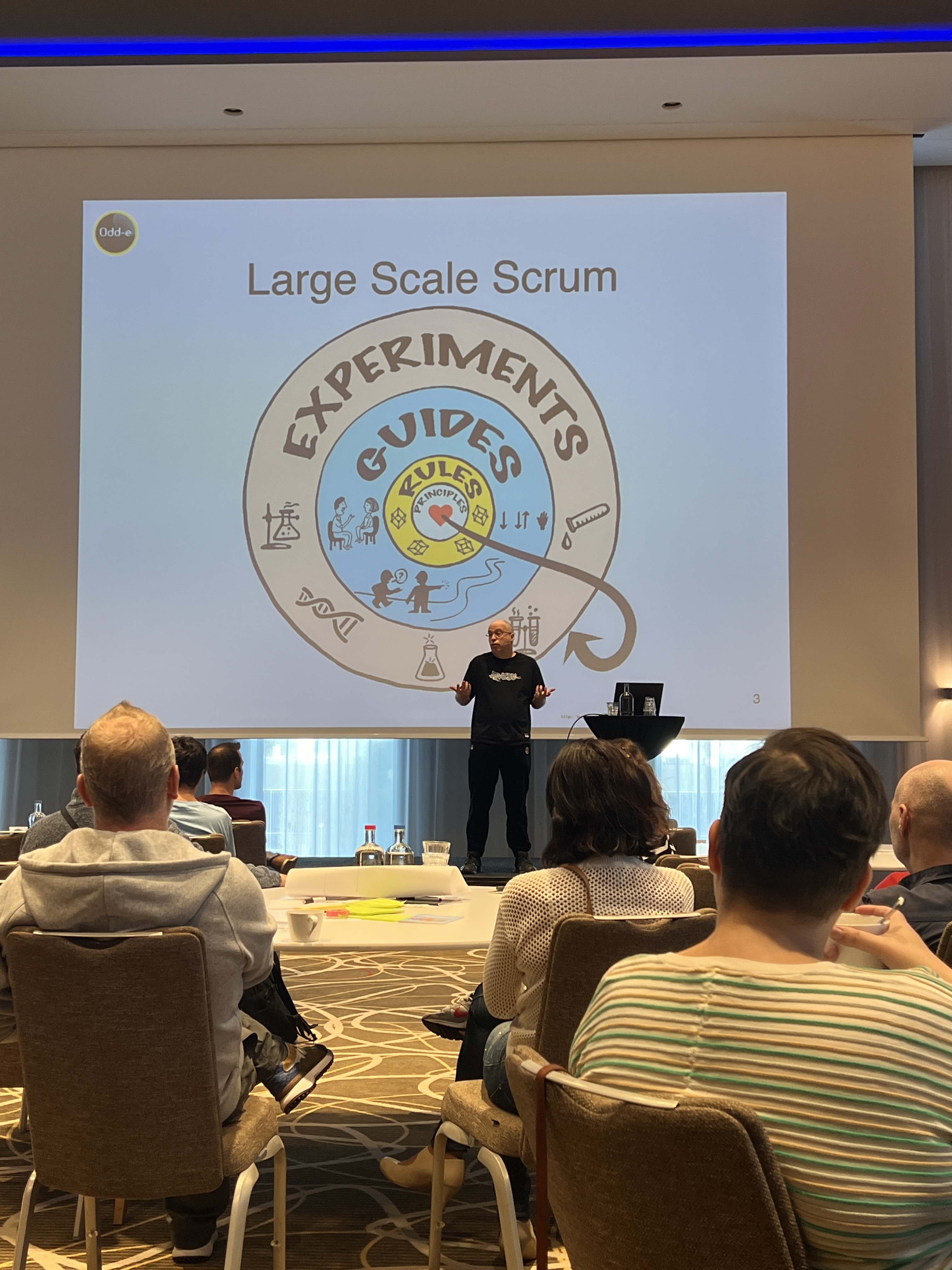
Speaker: Bas Vodde
I really liked Bas’s focus on the practical aspects of LeSS, particularly his deep dive into the product backlog. A lot of LeSS is derived from the product backlog, so understanding how to work with it effectively is fundamental to the framework. He provided numerous actionable tips and things to avoid, which made the session incredibly valuable.
As I listened to Bas’s suggestions, I found myself reflecting on our approach at Strobbo. Interestingly, most of what he recommended we already apply or avoid. This validation was both reassuring and thought-provoking — it suggests we’re on the right track, but also highlights areas where we might have room for refinement.
One particularly practical insight was about misusing priority for refinements. Bas pointed out that if work is at the bottom of the backlog, why would you refine it? This is such an obvious fix for a common challenge with new work, yet it’s something many teams struggle with.
His suggestion: put new work at the top until it’s refined. This simple workaround ensures that items get the attention they need before being properly prioritized.
In some of the routines I use with my teams, I actually extend this to work like version bumps, bugs, etc. where these are always first briefly discussed in Planning 1 (pick up, refine, discard). Are those the most important things? No, but you also don’t want to starve everything. And I think that our approach is then a combination of another tip to prioritize in buckets (bugs, …) and not force yourself to prioritize apples and pears.
One thing that I did pick up and where I’m a bit apprehensive about these days is too long term roadmaps. But in the case of Wartsila that Bas shared, they did have a 5 year roadmap for budgeting reasons. I’m apprehensive for this when used in a sales context, when ideas become actual commitments.
There’s a lot here to reflect on, and I think this topic is worth a future article. I’d like to map out Bas’s recommendations against the approach we’ve developed at Strobbo, which aims for the same outcomes but has some minor tweaks in how we practically tackle these challenges. The similarities suggest we’re converging on effective practices, while the differences might offer insights into alternative approaches.
Day 2 - Keynote by Maarten Dalmijn: Escaping the Kraken
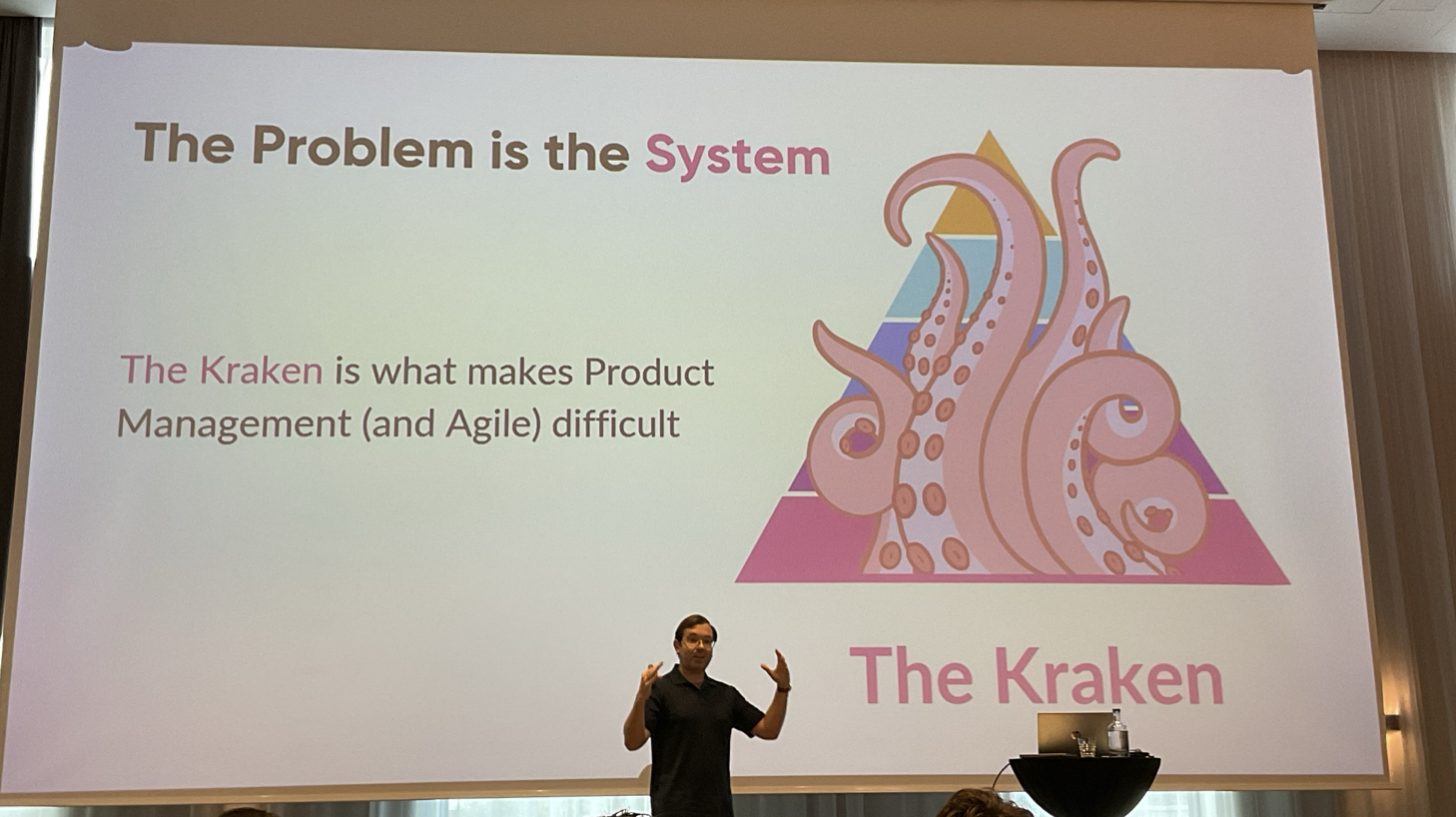
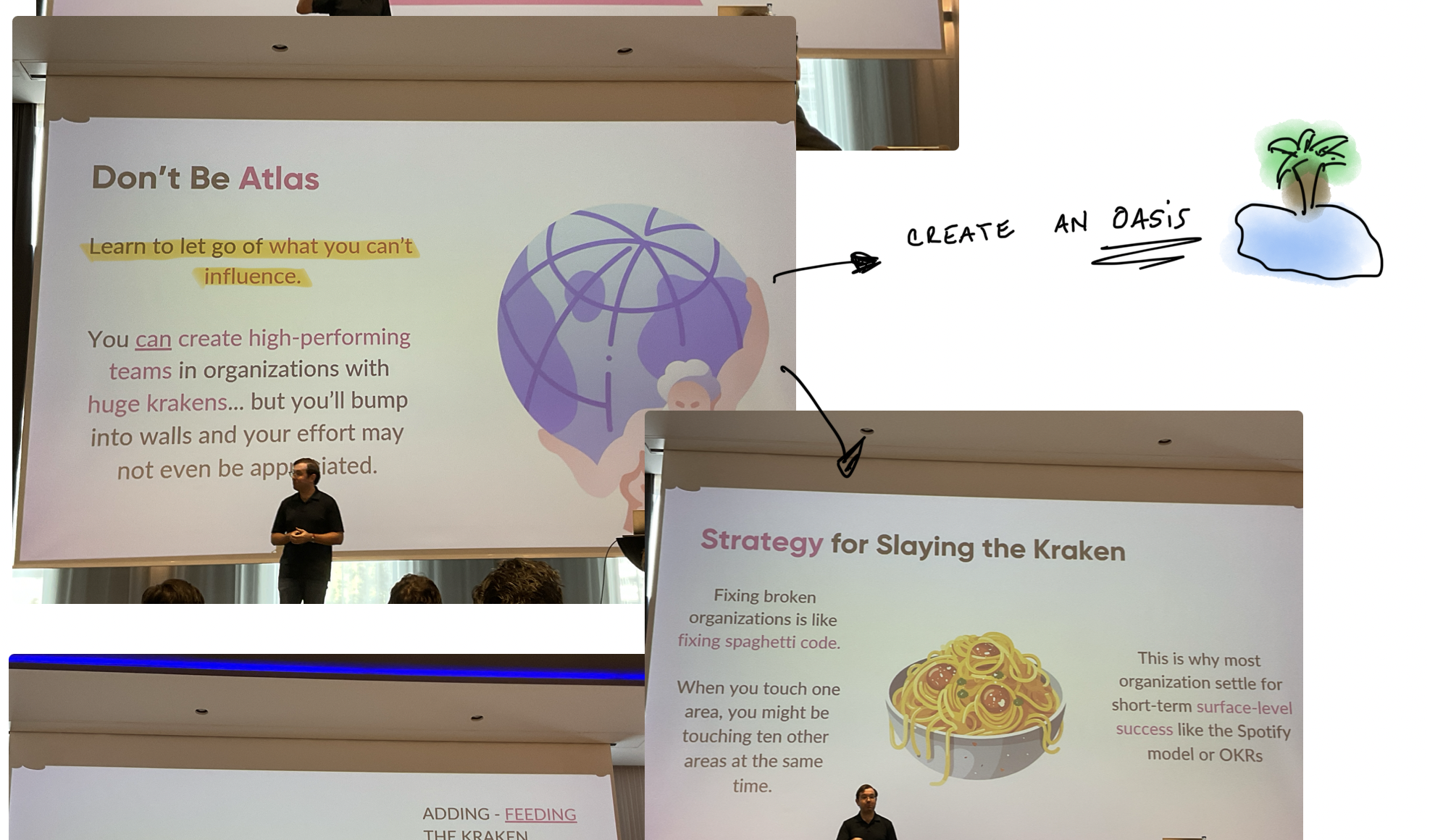
The final keynote from Maarten Dalmijn was very interesting, and I wanted to write down a lot more in my notes, but he was moving so fast through the slides that I’m going to have to watch this again when the recording comes out.
But very briefly, this is as close as you get to describing the problem that most Product Managers or PO’s live in from day to day. There was plenty of systems thinking in this talk too, but brought in a really approachable way (look up Cycle of Distrust).
Many of the obstacles that Maarten brings to the foreground are the ones I focus on fixing even though maybe that’s not what you expect from a PO/PM. Things like teams missing context (the goal of the work is not to finish the work), not enough autonomy, lack of collaboration and insufficient alignment.
But then keynotes are also meant to be inspiring right: my personal takeaway, and maybe at just the right time: ‘Don’t Be Atlas’, let go of what you can’t influence. You can’t win every battle, but you can create high performing teams even in organizations with huge krakens. If you really want to slay the Kraken, it’s akin to getting rid of spaghetti code. Maarten’s advice: get rid of things that breed distrust and feed the Kraken (Easy, immediate pleasure, familiar, no resistance), instead focus on creating trust (difficult, immediate pain, uncertain, risky, resistance). But as he said, sometimes we don’t like doing the difficult things so we turn to frameworks that already map nicely to the spaghetti we have (SAFe, Spotify, Team Topologies, …). Somewhere here I also mentioned that LeSS requires real change, fits the pattern that it is used much less in practice (pun intended).
Day 2 - Tom Jans’ Talk: Strongly Committed Teams — A Theory from Philosophy Applied to My Latest LeSS Flip
Tom Jans (simplytom.be) opened his session by introducing the concept of joint commitment, drawing from the philosophical work of Margaret Gilbert. He explored how this idea translates into agile teamwork and LeSS transformations, showing how teams move beyond individual intentions to act as a genuine collective.
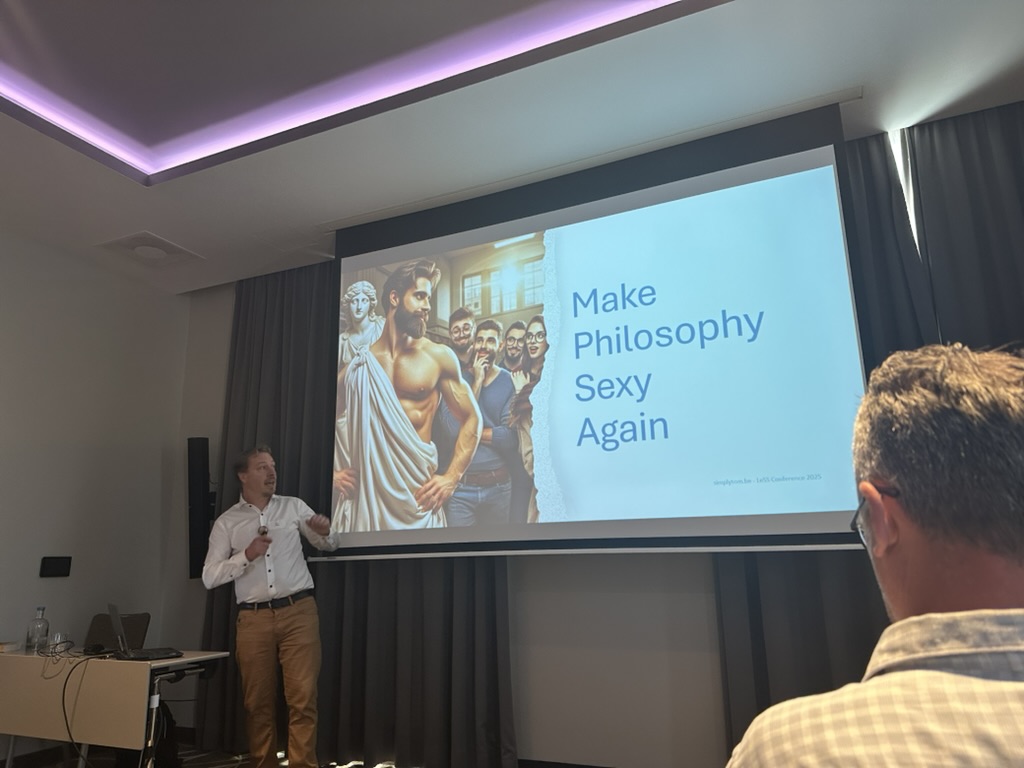
What Is Joint Commitment?
A joint commitment is more than each person deciding individually to pursue a goal. It’s a shared undertaking where people commit together as a body, creating a relational bond that gives rise to mutual obligations. This is what allows a group to act as a cohesive “we,” rather than a collection of “I”s. Once such a commitment is formed, each member has a reason to maintain it — not just for their own sake, but for the others who share in it.
A Takeaway: Resilience Through Shared Promise
One of Tom’s main takeaways was that strong joint commitment builds resilience. When a team has truly committed together, difficulties don’t signal the end of the road; they invite renewed engagement. Because the commitment is mutual, people feel compelled to address challenges, repair setbacks, and adapt — rather than walk away and risk breaking their shared promise. The commitment itself becomes a living force that keeps the team aligned when things get tough.
Seeing the Invisible: New Insights
Once you understand the concept of joint commitment, you begin to see why certain practices in agile teams matter so much — even when they don’t seem like “commitments” at first glance. Tom used team agreements and sprint goals as examples. These may look like simple coordination tools, but through the lens of joint commitment they become relational anchors. They tie the team together behind a shared purpose and create the social glue that makes mutual accountability and care possible.
Day 1 & 2 - Open Space Sessions
The Open Space format was a highlight of the conference, allowing participants to propose and attend sessions on topics that mattered most to them. The marketplace was bustling with diverse topics ranging from technical practices to organizational challenges.
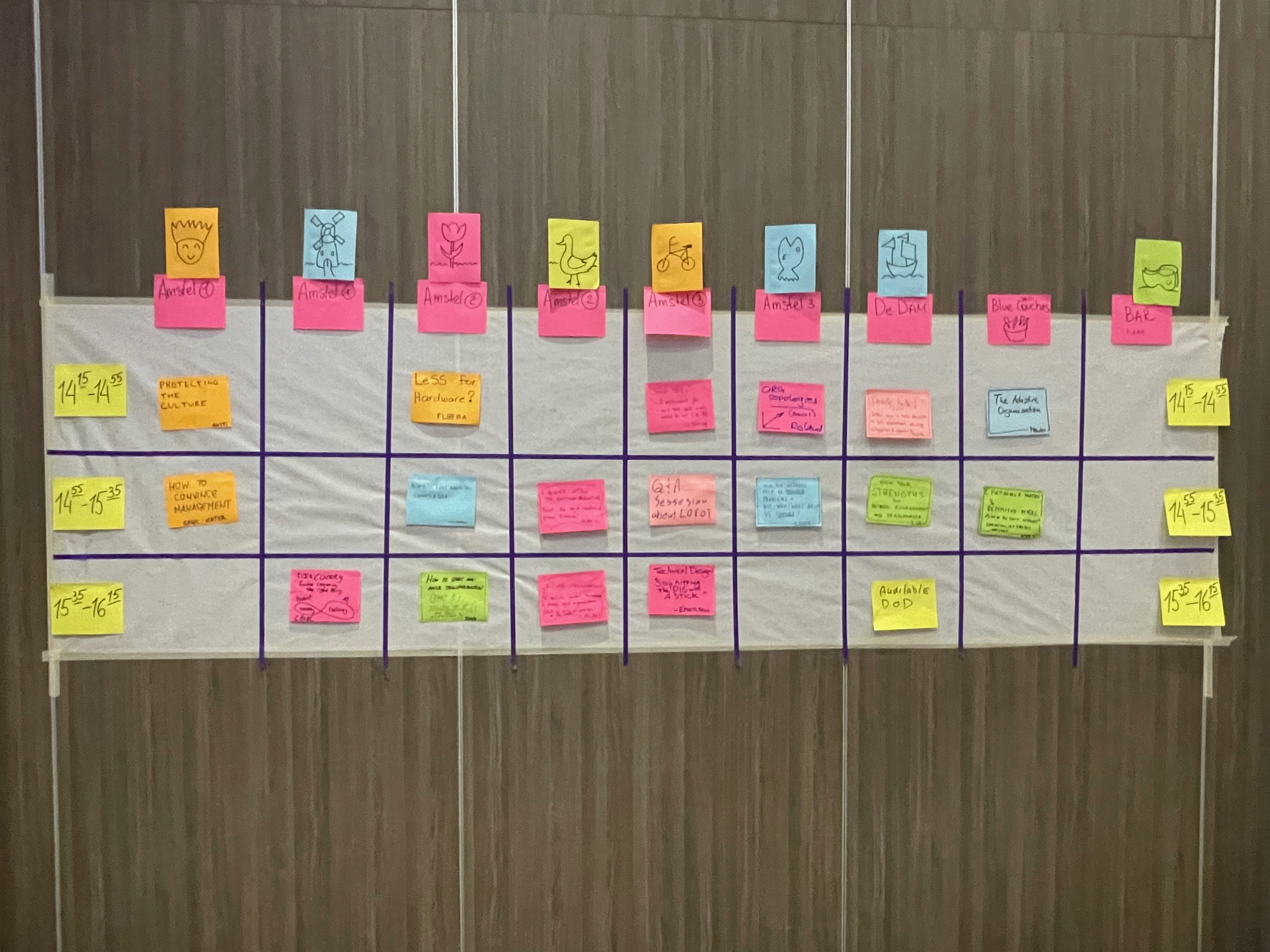
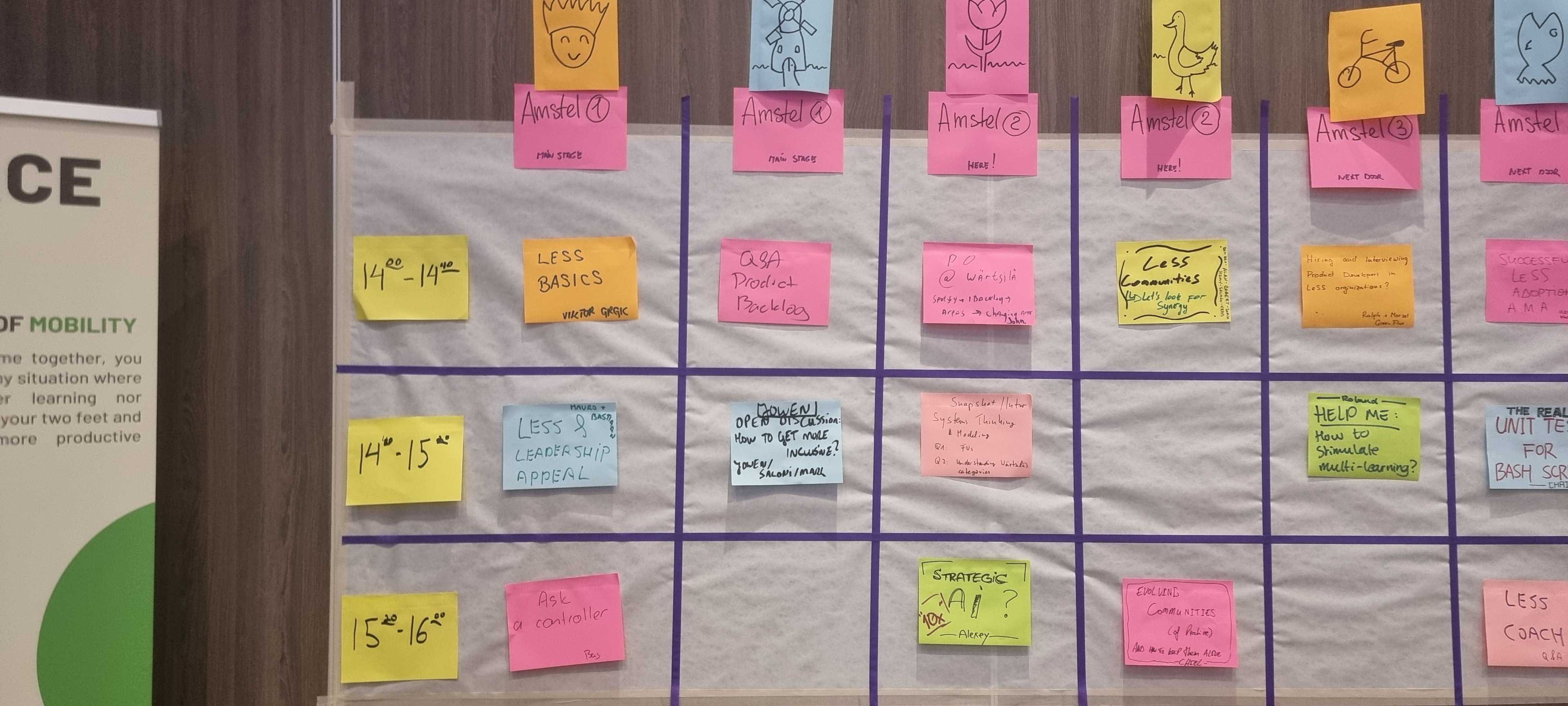
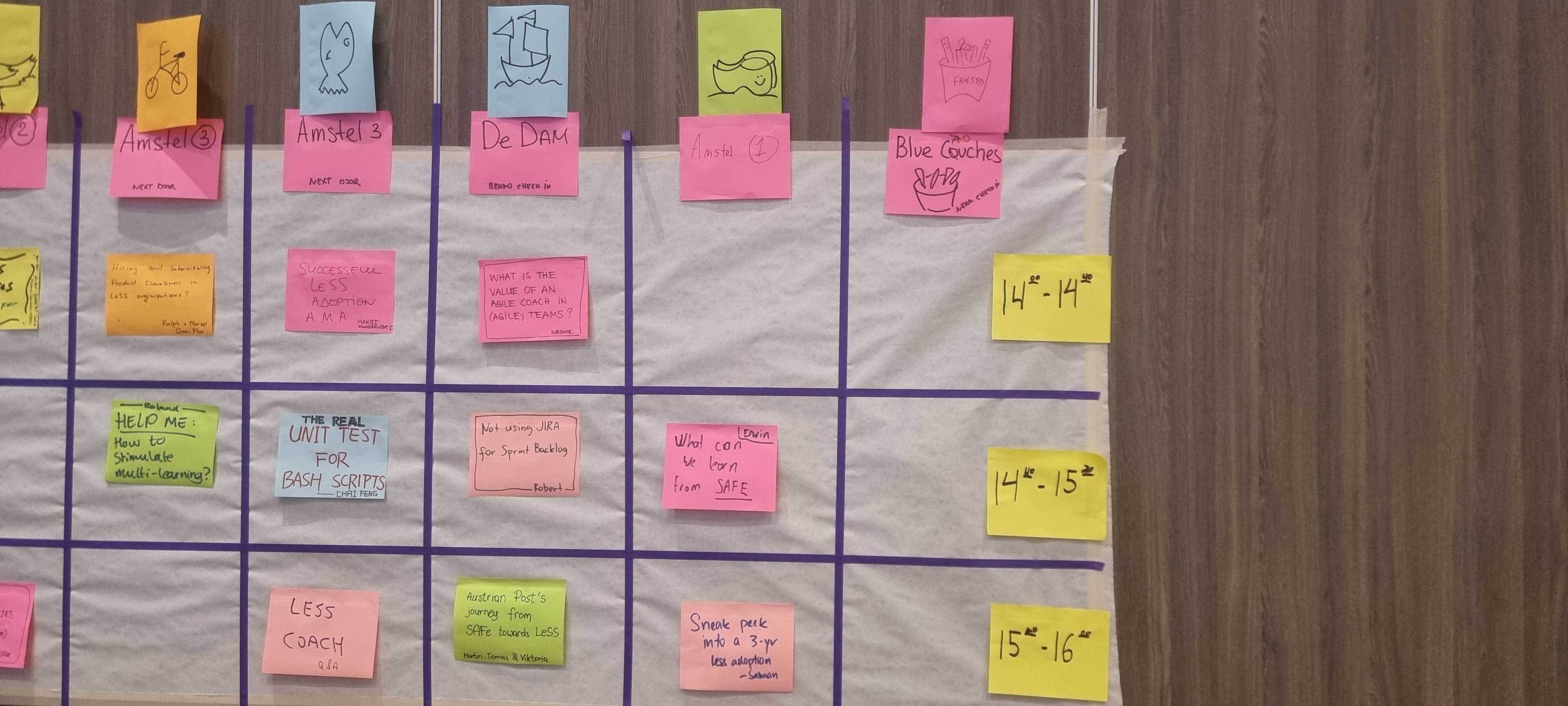
Day 1 & 2 - Open Space — Talking to Leadership and Management about LeSS
I joined both of these sessions because I’ve found myself struggling with this challenge too. It’s not an easy topic to bring to management, and I was curious to hear different perspectives on how to navigate these conversations effectively.
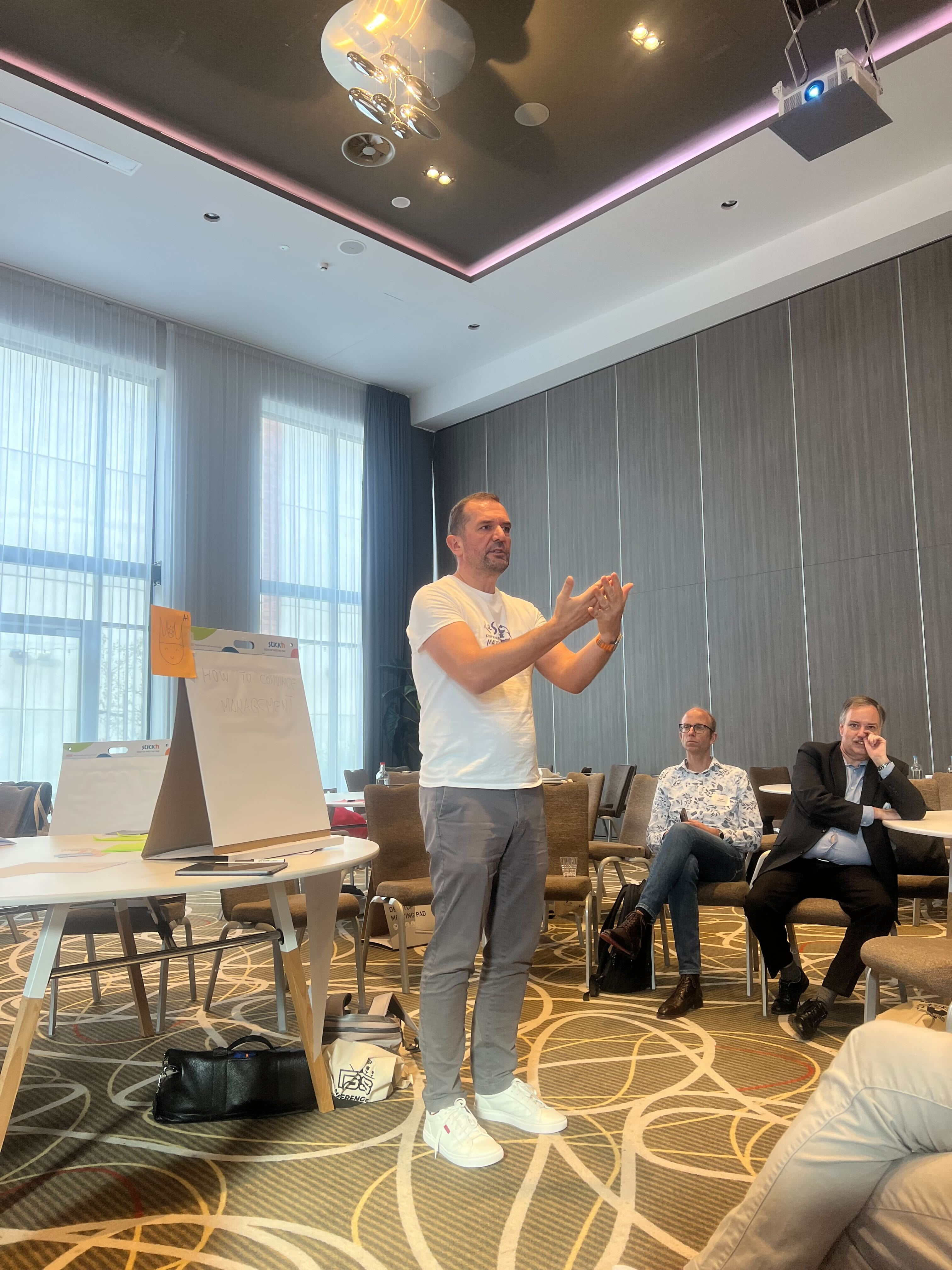
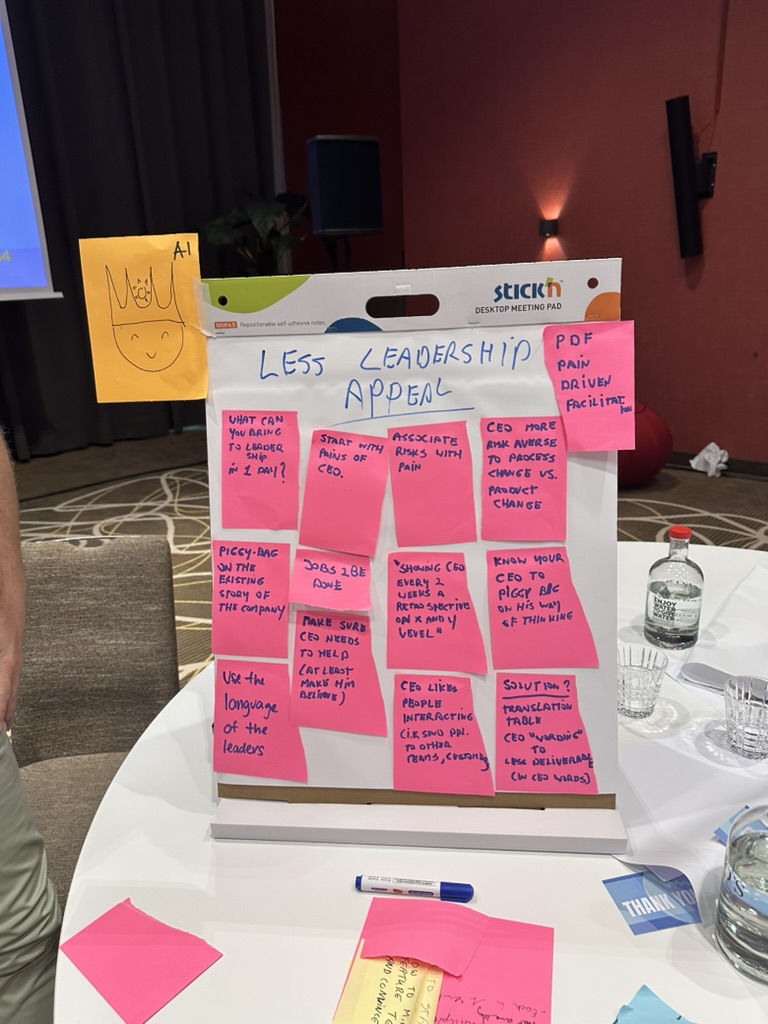
Two Open Space sessions — one with Viktor Grcic, the other with Bastiaan, CEO of the LeSS Company — explored how to engage management and leadership in meaningful conversations about LeSS.
Both emphasized that transformation begins not with a framework but with understanding the organization’s reality.
The Core Challenge
Executives live in a world of constraints — commercial pressure, risk, and expectations of predictability. The key is to approach them with genuine curiosity and empathy, uncovering what they are really trying to optimize for. From there, you can connect LeSS principles to tangible business concerns such as decision latency, coordination overhead, or slow learning cycles.
Viktor’s Approach: “How to Convince C-Level to Do Transformation to LeSS”
Viktor’s session emphasized genuine curiosity over sales tactics, using storytelling to build bridges, and confronting hesitation with consequence-focused questions.
Rather than pitching adoption, the focus should be on improving outcomes: delivering value faster, reducing waste, and enabling learning across teams. The tone was pragmatic and respectful — avoid agile jargon; speak about value, speed, and responsiveness. Show evidence, not ideology.
When leaders become hesitant or try to back away, Viktor’s approach was particularly effective: confront the consequences of not addressing the problem directly, then position yourself as the expert while leaving them room to find their own solution. Questions like “So you don’t want to solve the problem of most of your teams not working on what is most important?” followed by “So how would you solve this problem in other ways? Because I only know the solution that I suggested to you” — this technique closes the door on inaction while opening space for their own discovery.
Empowering Agile Coaches: A Different Approach
Bastiaan’s session had a different goal: finding ways to empower agile coaches in their conversations with leadership. While Viktor shared his personal approach to engaging executives, Bastiaan focused on understanding how leadership looks at risks and decision-making, then translating that into tools coaches could use.
We leaned into the idea that you could approach this from a “jobs to be done” lens: understand their struggles, see what outcomes would be perceived as positive, and only then dive into solutions. This could lead to creating a translation table that helps in these discussions and allows coaches to piggyback on leadership’s way of thinking.
We noticed that in most cases, leaders will not be opposed to people interacting more or taking more ownership. They’re just not sure how to truly realize that — and that’s exactly where agile coaches come in.
Broader Conference Context
A few additional insights emerged from other conference discussions:
-
It takes time and you can’t push this. Real organizational change requires patience and can’t be rushed or forced.
-
LeSS requires real change. As Craig Larman emphasized in the Q&A, LeSS demands genuine transformation of how work gets done. As Maarten Dalmijn pointed out in his talk, frameworks like SAFe and Team Topologies are often easier to deploy because they typically map pretty directly onto existing organizational structures.
💬 Transformation doesn’t start when management approves LeSS; it starts when they join the conversation about what’s getting in the way of delivering value.
Day 2 - Open Space — Strategic AI vs Naive AI
Facilitated by Alexey Krivitsky
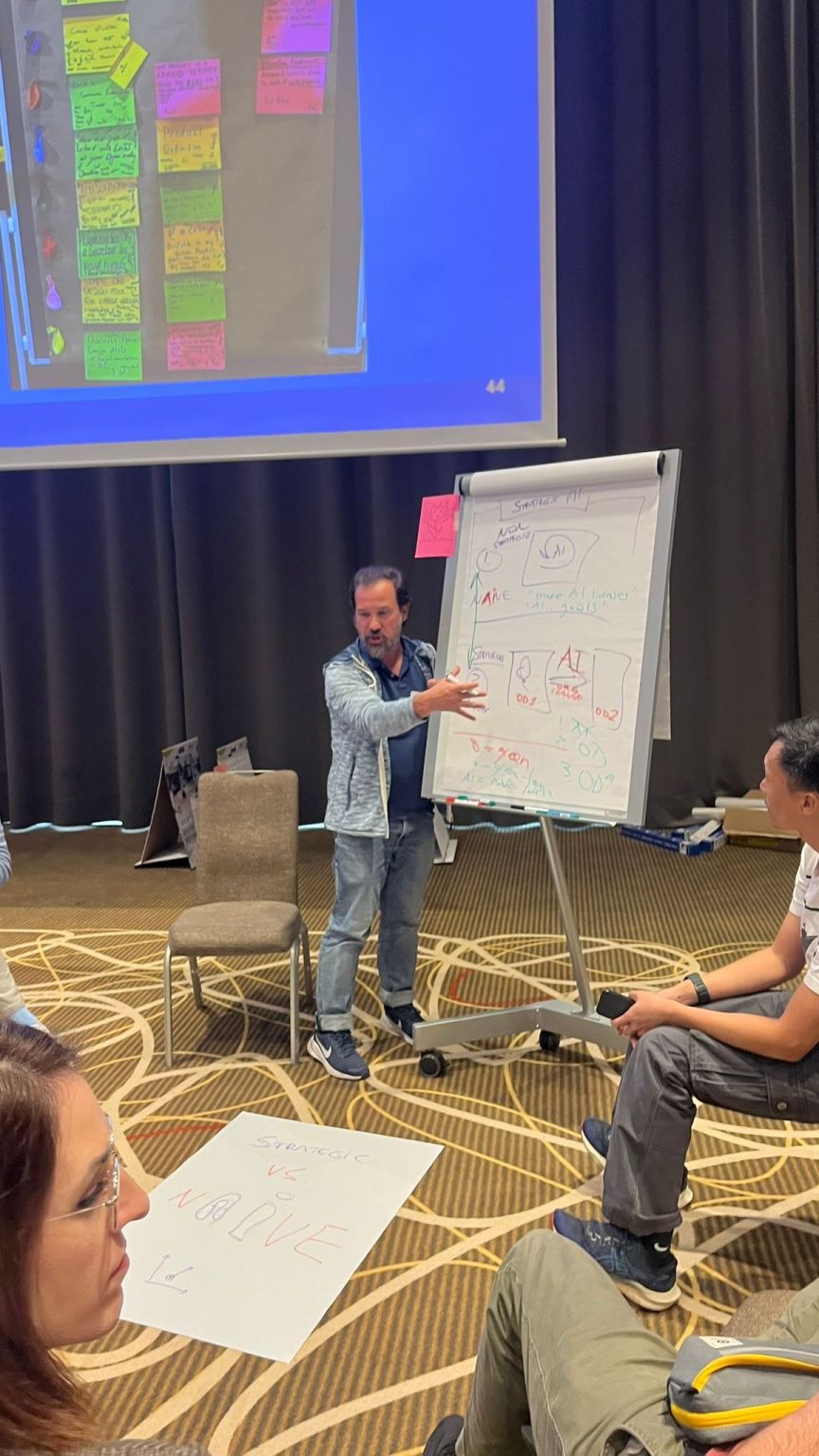
This was a really insightful discussion about how we need to reflect carefully about when AI is just local optimization vs a really strategic and systemic change. This connects back to Alistair’s talk about errors in organizations — using AI locally can lead to the effect of just speeding up making mistakes, for which the organization is not equipped to handle them effectively, and could make things even worse. We need to really see where it can make a difference.
After thinking about it, I put this on LinkedIn:
“And speaking of #LeSS2025 — where AI was, of course, one of the many topics on everyone’s mind — it struck me that if we’re already struggling to figure out how to apply it strategically within our companies, how on earth are we going to understand how it truly fits into our products and solves real problems for our customers and users?
When we talk about another bubble about to burst, I think it’s the one filled with local optimizations — applying AI here and there inside our products, or in our internal processes, without really rethinking the problems they’re meant to solve. I’m getting more and more convinced that you can’t look at organizational design and product design as two separate things — you need to rethink both together.
And that probably also means reflecting a bit more on trust. Most of us don’t really understand how AI makes its decisions, yet those decisions increasingly shape the way we work. Maybe the real challenge is figuring out how we can apply it in ways that let us collaborate with AI, instead of just letting it quietly take over parts of our work.
If we want to shape the future of our products, our organizations need to be designed for that purpose — built to learn, adapt, and stay close to the people we’re building for. Only then can we build products that evolve with their users — not just automate what already exists.”
📚 Books Referenced at the LeSS Conference 2025
Finally, I always keep my mind open for new books to read, and these are the ones I spotted in the presentations:
Host: Six New Roles of Engagement by Mark McKergow & Helen Bailey
Amazon • Publisher site
Introduces the idea of “Host Leadership,” a modern framework for engagement where leaders act as hosts rather than heroes — moving flexibly between six roles such as Initiator, Inviter, and Space Creator.
Lateral Leadership: Getting Things Done When You’re Not the Boss by Roger Fisher & Alan Sharp
Amazon • Goodreads
A practical guide to influencing without authority — applying negotiation and collaboration techniques to lead across teams and hierarchies.
Joint Commitment: How We Make the Social World by Margaret Gilbert
Amazon • Goodreads
Explores the concept of “joint commitment” as the foundation of collective actions, shared beliefs, and obligations that make up our social world.
On Social Facts by Margaret Gilbert
Amazon • Goodreads
A foundational philosophical work on how social groups, conventions, and collective intentionality arise through mutual understanding and shared commitments.